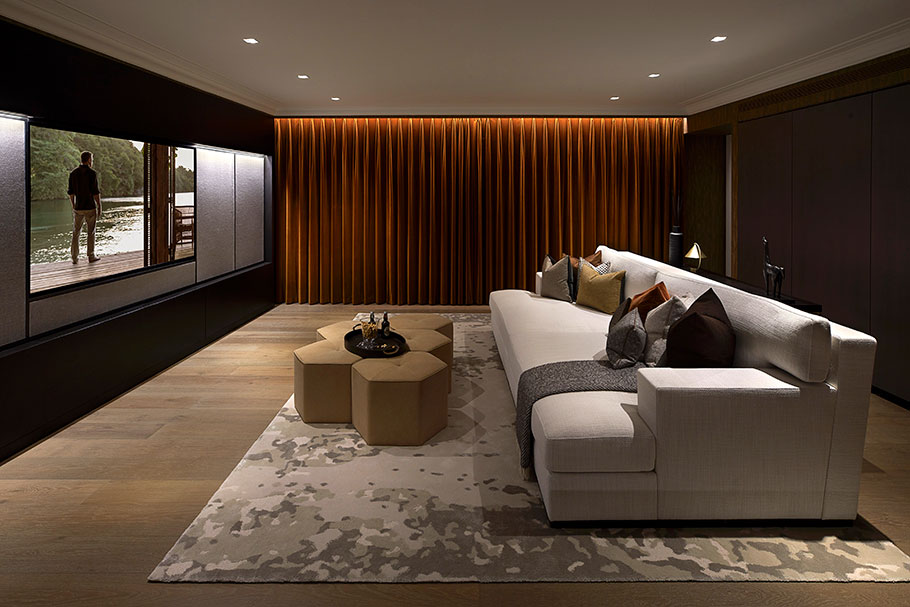
Technology is everywhere, arguably more so now than ever before. Having what’s known as a ‘Smart Home’ has become an increasing requirement among many. The ability to enhance security, improve energy efficiency and create convenience is particularly attractive to anyone looking to enhance their lifestyle.
The first wave of smart home adoption was product-led. A homeowner might install intelligent lighting to reduce energy use, add a video doorbell for security, or introduce automated blinds for convenience. Each innovation solved a problem. However, these systems often operate independently, each with its own app and interface. The result can be impressive but fragmented – a collection of clever tools rather than a seamless living experience. For many homeowners, this is no longer enough. Today’s ambition is not simply to have a smart home, but to have a home that thinks as one.
As the capabilities of technology expand, one would be forgiven for being under the illusion that provided a tool is installed correctly, it will reach its potential in terms of offering. This however is no longer the case, as without coordination, systems have potential to become more of a hinderance than a help. An individual system can work well, but when you add to that several other systems that have no overall control capabilities, you add time and energy in to things that should be reducing both.
It’s important to highlight that often a home already has infrastructure in place, particularly when new homeowners are making it their own. This is a time when alignment is not only a possibility, but a key factor. We spoke to Richard Colman from Luxe Smart Homes based in Cobham, Surrey, who gave us some insight into the importance of this: ‘Many luxury homes come with technology already in place, but it is often from another era, with limited cabling, ageing equipment and systems that no longer reflect how people want to live today. For new homeowners, the priority is rarely starting again, but understanding what is worth keeping, what should be updated and how the house can work more intelligently without unnecessary disruption.
A well-planned smart home brings the key systems in a property into alignment, from lighting, Wi-Fi and entertainment to security, heating and shading. Our approach is to work with the home as it stands, making the best use of existing infrastructure where practical, modernising where it matters and ensuring the technology feels discreet, reliable and easy to live with from day one.
As expectations continue to shift, connected living is becoming a natural part of the modern luxury home. Features that once felt advanced are steadily becoming standard, which makes thoughtful, well-coordinated upgrades increasingly important for comfort today and long-term relevance in the years ahead.’
Integration is Key
Artificial intelligence has quietly woven itself into the fabric of modern living. From all-in-one security systems to predictive lighting and energy management, AI tools are now commonplace in homes across the UK. However, while many properties boast individual pieces of smart technology, the true frontier of luxury living lies not in owning more devices, but in bringing them together.
AI enables systems to learn routines, anticipate behaviour and adapt according to occupancy patterns, daylight levels and even energy tariffs. Over time, the home refines its responses, creating an environment that feels intuitive rather than programmed. The goal is frictionless living – fewer manual adjustments, fewer competing interfaces and technology that fades into the background.
When technology tools in the home communicate in real time, the property functions as a unified ecosystem rather than reacting to isolated instructions. Imagine arriving home on a winter evening and having the driveway lighting respond as your car approaches. Perhaps the entrance hall adjusts to your preferred temperature. Maybe the security system knows to disarm discreetly for recognised family members. These are examples of how smart homes can respond holistically.
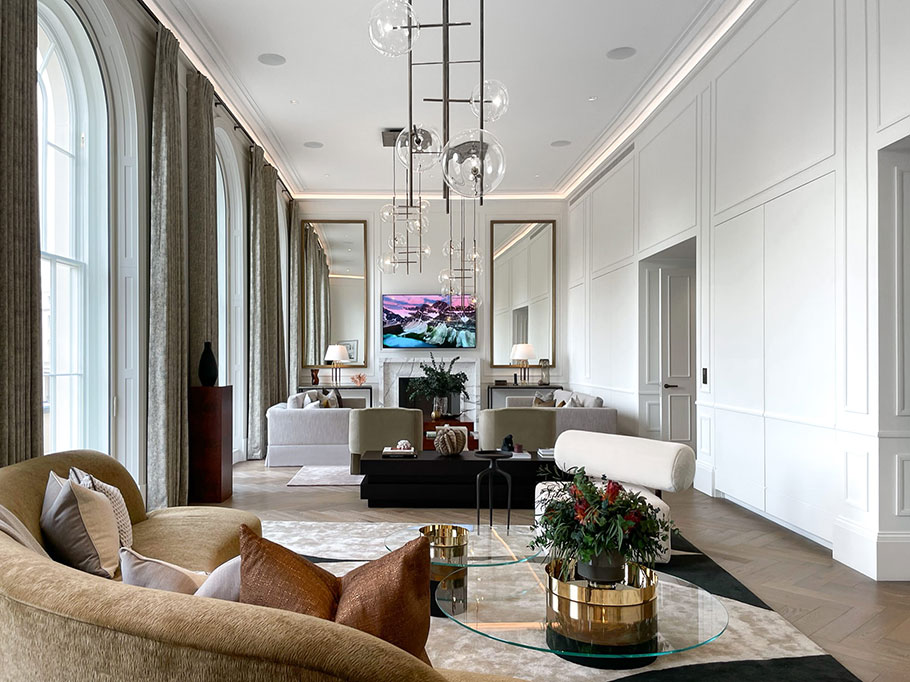
Image Credit: Luxe Smart Homes
Crestron and the Unified Platform
At the heart of this movement are specialist integration platforms, with Crestron widely regarded as a leader. Unlike standalone devices, Crestron acts as a centralised control system, bringing together lighting, climate, shading, security and audio-visual technology into one coherent interface. Rather than navigating multiple apps, homeowners interact with a single, refined system via discreet wall panels, touchscreens or mobile devices. Importantly, Crestron is brand-agnostic. It integrates with a wide range of technologies, acting as the conductor of a complex orchestra. In many prime and super-prime homes, it’s specified at design stage and embedded within the infrastructure, ensuring intelligence is built into the architecture rather than retrofitted later.
Whilst integration is a key aspect of smart living, the importance of selecting the right individual AI tools remains, and is certainly not something to be bypassed. What were once-upon-a-time very reactive systems, are now progressing to proactivity, something that has significantly improved the technology landscape.
Image Credit: Luxe Smart Homes
From Reactive Cameras to Predictive Security
Security is one of the areas where AI is evolving most rapidly. Early smart home security centred on reactive alerts. A motion-triggered camera would send a notification. A video doorbell would record a visitor. Homeowners would review footage after the fact. Increasingly, that model is being replaced by AI-powered monitoring.
Advanced systems can now transcribe activity in real time, describing what is happening within the video feed rather than simply flagging motion. Instead of a generic alert, a homeowner might receive a notification that reads: “Delivery driver at front door” or “Unknown individual approaching side gate.”
Paired with facial recognition, these systems distinguish between family members, regular visitors and unknown individuals. The home can respond accordingly – unlocking for recognised occupants, escalating alerts for unfamiliar faces or activating additional lighting and recording protocols when required. This represents a shift from passive recording to predictive awareness. Within a cohesive ecosystem, security does not operate in isolation. It can trigger lighting scenes, notify monitoring teams, adjust access controls and log events centrally on a secure local network. The result is not only greater safety, but a system that actively interprets its surroundings.
Want to discover more? Request your complimentary copy of Prime Magazine, our luxury lifestyle magazine, showcasing a selection of the finest homes that we have for sale throughout Surrey and south west London alongside luxury lifestyle articles from hand-picked partners and businesses across the county.